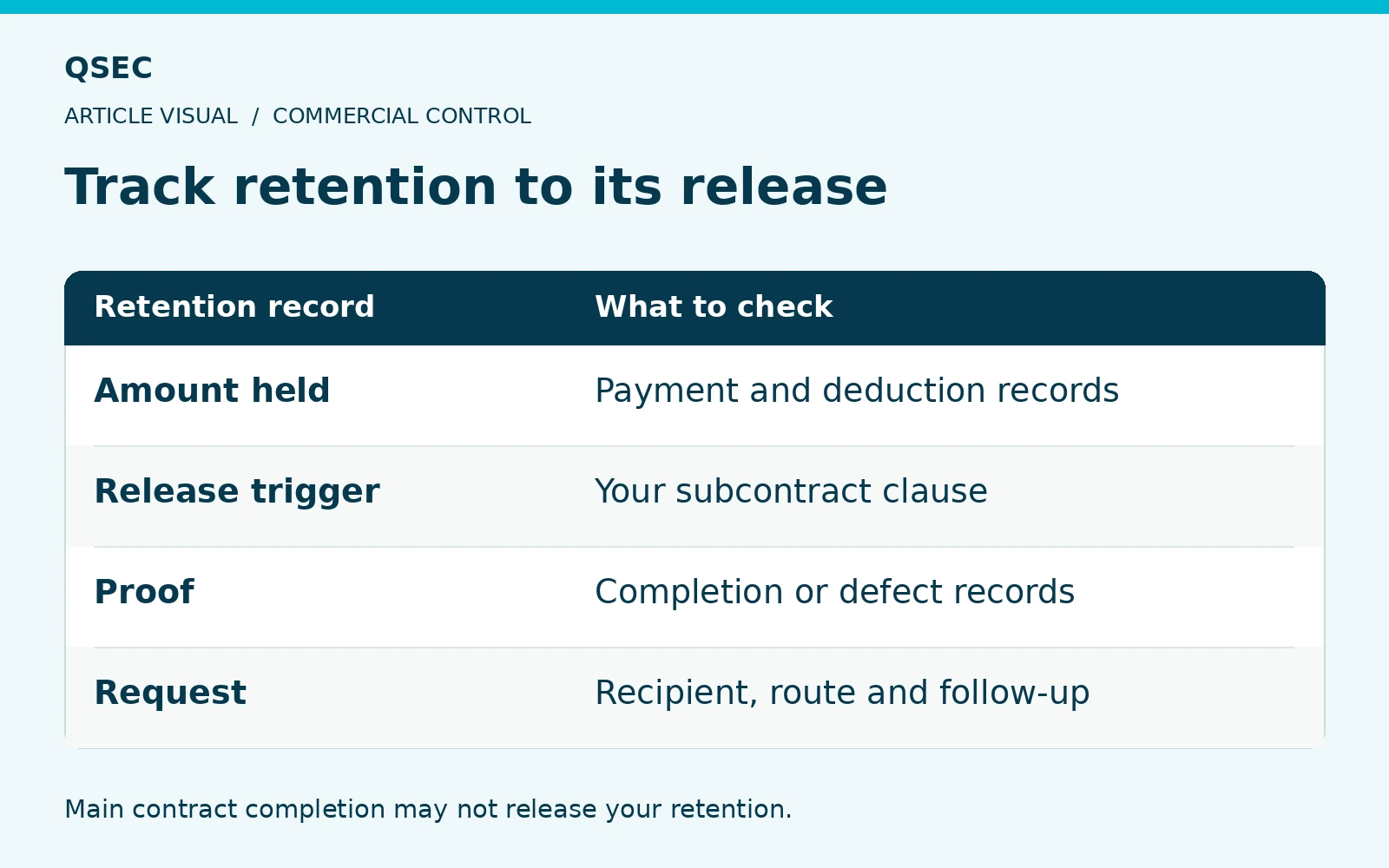
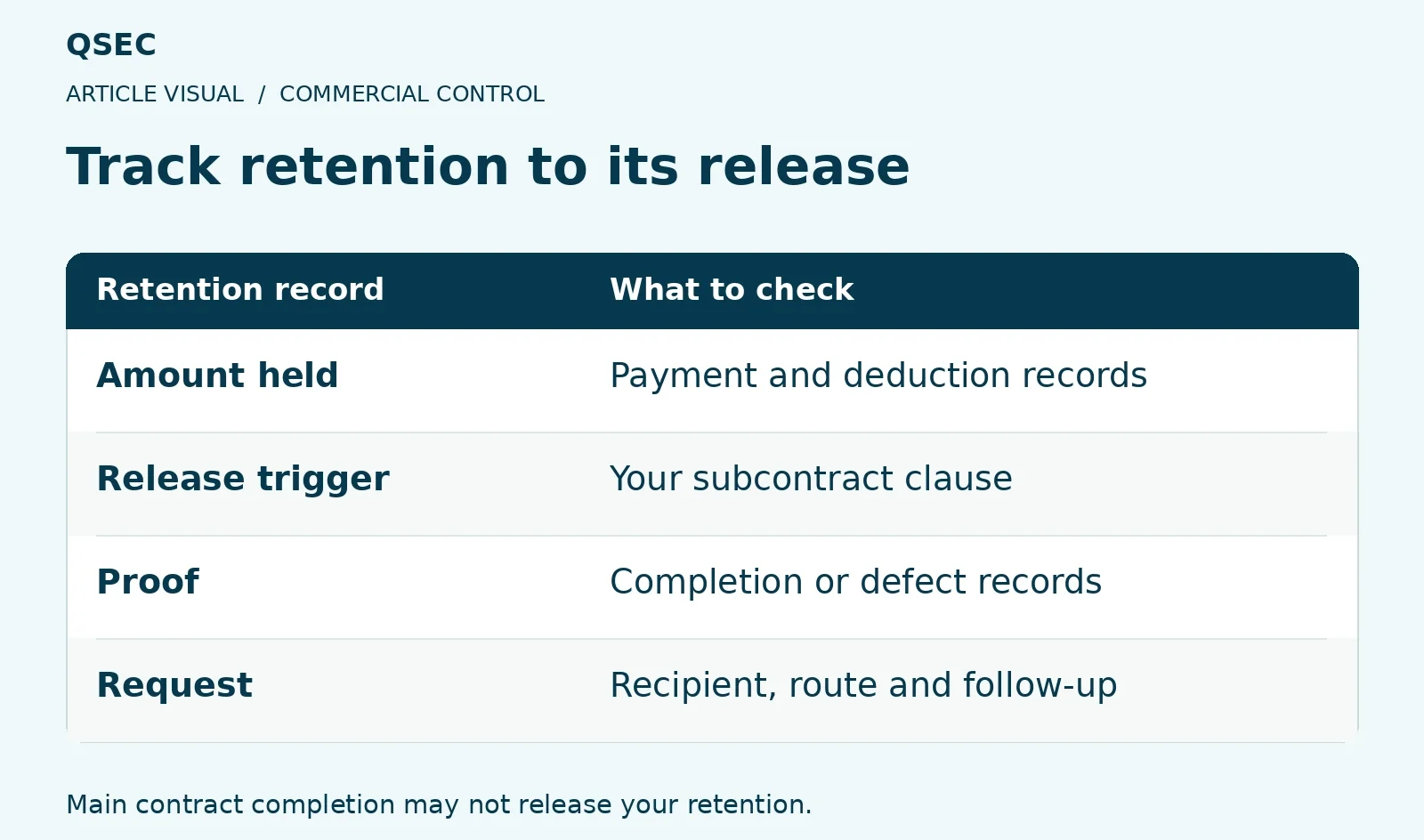
How to understand retention provisions, keep the right records and reduce avoidable delay in release.
Start with the actual contract
Retention is a contractual deduction rather than a general industry entitlement. The percentage, cap, release stages and conditions should be checked against the signed terms, including any amendments and downstream provisions.
Do not assume that the main contract and subcontract use the same triggers. Practical completion, sectional completion, completion of the subcontract works and expiry of a defects period can produce different dates. Record the clause, event, evidence and application date that apply to each release.
Payment legislation and contract wording can interact in ways that depend on the facts. Where the entitlement or payment mechanism is disputed, obtain project-specific contractual or legal advice rather than relying on a standard industry practice.
- Record the retention percentage and maximum
- Diary the contractual release triggers
- Separate retention from other disputed deductions
- Keep evidence of completion and defect rectification
Build the release evidence before it is due
A clear record of completion, handover, defects, rectification and certification gives the commercial team a stronger basis for requesting release. Waiting until the payment date to reconstruct this material creates unnecessary delay.
Keep a simple retention schedule by project. It should show the original contract value, approved change, retention deducted to date, any cap, the amount expected at each stage and the evidence still outstanding. Reconcile that schedule to applications and payment notices so the amount requested can be followed.
- Completion and handover records
- Defects lists and close-out evidence
- Applications and payment notices
- Correspondence confirming the relevant release event
Track partial releases and package completion
On phased or package-based work, different parts of the subcontract may reach the relevant milestone at different times. If the contract permits sectional or partial release, record the scope and value associated with each section. This can prevent a completed element from remaining tied to unrelated outstanding work.
Where release depends on documents, make the requirement explicit. Operation and maintenance information, warranties, test certificates, as-built information and evidence of defect rectification should be assigned to an owner and target date.
- Reconcile retention to every payment cycle
- Identify each contractual release event
- Record documents and defects still outstanding
- Apply in the format and by the date required
Address disagreement precisely
If retention is not released, identify whether the disagreement concerns the trigger, the amount, an alleged defect, a set-off or the payment procedure. A focused response is usually more effective than treating every issue as one general non-payment dispute.
Set out the clause relied on, the event that has occurred, the amount calculated and the supporting documents. Ask the other party to identify the contractual and factual basis for any contrary assessment. This narrows the questions and gives both teams a usable route to resolution.
Practical next step
Before acting, check the signed contract, current project information, relevant dates and contemporaneous records. If the position affects payment, programme or entitlement, a focused review can identify the evidence, decision and immediate action required.
Related QSEC services
Continue with valuations and payment support, variations and final accounts and commercial management, or discuss the project with QSEC.