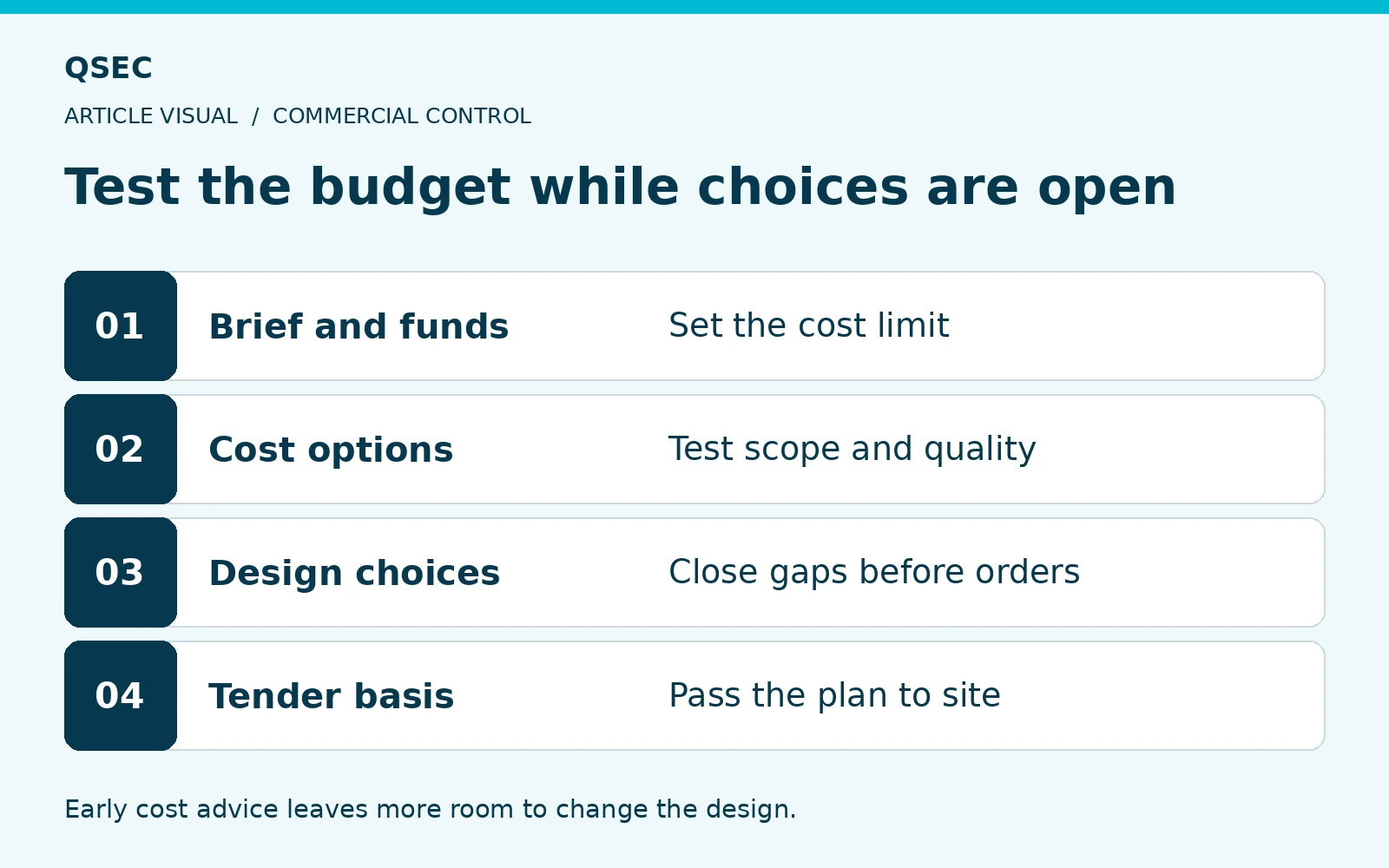
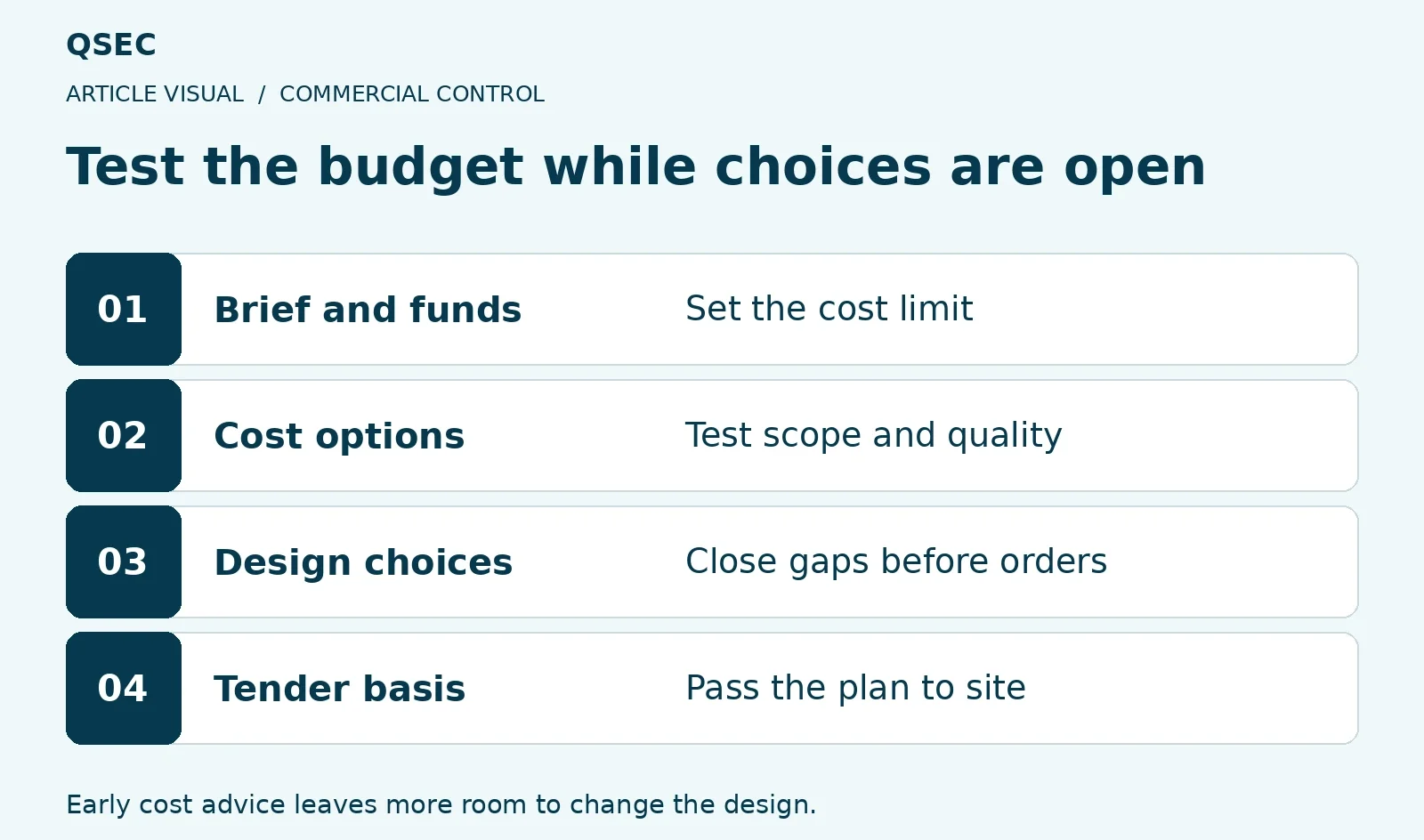
The practical benefits of connecting scope, design, cost, risk and procurement before key decisions become fixed.
Early advice creates decision time
The greatest value of early cost advice is not simply a lower estimate. It gives the project team time to understand the cost consequence of the brief, compare options and resolve uncertainty before planning, design or procurement commitments restrict the available choices.
An early cost consultant can translate the brief into measurable cost drivers: area, specification, abnormal work, phasing, access, services, programme and risk. The first estimate is then a decision model with stated assumptions, not a promise based on incomplete information.
- Test whether the brief and budget align
- Identify high-risk or information-poor elements
- Compare procurement and phasing options
- Set a transparent baseline for later change
Assumptions must remain visible
An early estimate inevitably contains assumptions. A good cost plan identifies them, assigns actions and is updated as information improves. This prevents an allowance from being mistaken for a fully designed and market-tested price.
The cost plan should distinguish measured scope, design allowances, provisional quantities, inflation, risk and client contingency. When one of those items changes, the report should show the movement against the previous baseline and explain the decision required.
- State the information date and design stage
- Record exclusions and client-supplied items
- Allocate risk owners and review dates
- Keep option costs separate from the approved baseline
Procurement can be tested before tender
Design maturity, programme, market appetite and the client’s capacity to manage risk all influence the procurement route. Early commercial input helps the team test package strategy, tender timing, contractor involvement and the consequences of transferring incomplete design risk.
A procurement recommendation should connect those factors to the project priorities. The cheapest headline route is not necessarily best value if it creates unpriced qualifications, a weak tender comparison or change immediately after award.
Change control starts with the baseline
A project cannot explain change unless the approved position is clear. Early engagement creates the scope, cost and risk baseline against which later design development can be measured. This makes value engineering and budget decisions more transparent because the team can see both the saving and any consequence for quality, programme or operation.
Better handover into delivery
When the estimate, tender return and delivery budget can be reconciled, the construction team inherits a controlled commercial position rather than a new spreadsheet with no explanation of how it was formed.
The handover should identify the accepted tender adjustments, remaining qualifications, risk allowances, procurement gaps and immediate actions. Maintaining that thread reduces the chance that known pre-construction issues reappear later as unexpected cost or programme pressure.
Practical next step
Before acting, check the signed contract, current project information, relevant dates and contemporaneous records. If the position affects payment, programme or entitlement, a focused review can identify the evidence, decision and immediate action required.
Related QSEC services
Continue with quantity surveying and cost management, pre-construction management and value engineering and cost assurance, or discuss the project with QSEC.